
Baseball scorekeeping means everyone has a style of their own
I found out at age 12 that my dad and I had distinctively different methods.

One of the benefits of darting in and out of sports media as a professional is not only personally meeting icons, it’s being able to tell them what you appreciate about their craft.
So it was when I told Ernie Harwell, “I love that you tell the score a LOT.”
Baseball on the radio is as much enhanced as it is ruined depending upon how much—or how little—the announcer reveals the score.
There’s one thing and one thing only a listener wants to know when he flips on the game on the radio: the freaking score.
Ernie Harwell never kept his listeners waiting for very long for this precious information.
Ernie thanked me, but also told me why he did it.
It was an old trick told to him by the great Red Barber.
“Red had a 3-minute egg timer in the booth,” Ernie said as we waited in the Green Room prior to a cable TV interview he was doing for a program I produced. “And when the sand in the timer ran out, Red gave the score and flipped the timer over.”
Clever.
But I write today not about baseball score-giving but about something tangential.
Baseball score-keeping.
I find baseball scorekeeping fascinating because it seems like everyone has their own hieroglyphics.
It’s not like bowling, for example, where you’re duty bound to fill in the frames a certain way.
With baseball scorekeeping, the sky’s the limit. It’s YOUR scorecard. YOU can do whatever you want. Damn the torpedoes!
There are few “rules” when it comes to keeping score of a ballgame.
Maybe not even a few: maybe just one.
As far as I’m concerned, all you need to do is correctly identify the players by their numerical positions, 1 thru 9. Beyond that, anything goes—as long as you can understand it.
My introduction to different methods of scoring happened when I was 12 years old.
Somehow I had developed a style, even at that age.
One night at Tiger Stadium, I excused myself to go the little boys room during the game and thus left my “official” Tigers scorebook in the hands of my father.
When I returned about a half-inning later, I looked at my scorecard to see strange symbols and scribbles. My father obviously had HIS own style of scoring, and utilized it. Forget that it totally clashed with mine!
When it comes to base hits, I’ve simply used “1” for a single, “2” for a double and so on. But I’ve also morphed to “1B,” “2B,” etc. Once, a home run was a “4” before it became “HR.” Regarding homers, my dad used to draw a vertical “antenna” line to indicate in which direction the ball was hit, on top of four stacked horizontal lines.
So a ball hit over the left-center field fence had a vertical line pointing to 11:00, if you follow me.
Since I continue to play tabletop sports games almost nightly, I’m still scoring ballgames—even if they’re not real. But at least I don’t get rusty!
Baseball scorekeeping is, at the same time, extremely personal yet also something you’re not afraid to share publicly. I bet you could have a lively pub discussion about this topic revolving around why each person thinks their system is the best.
There are almost as many different formats of scorebooks as there are scoring styles. Google “baseball scoresheet” and your mind will be blown. Some favor empty grid squares, while others have those little baseball diamonds embedded into each grid square, practically begging to be filled in.
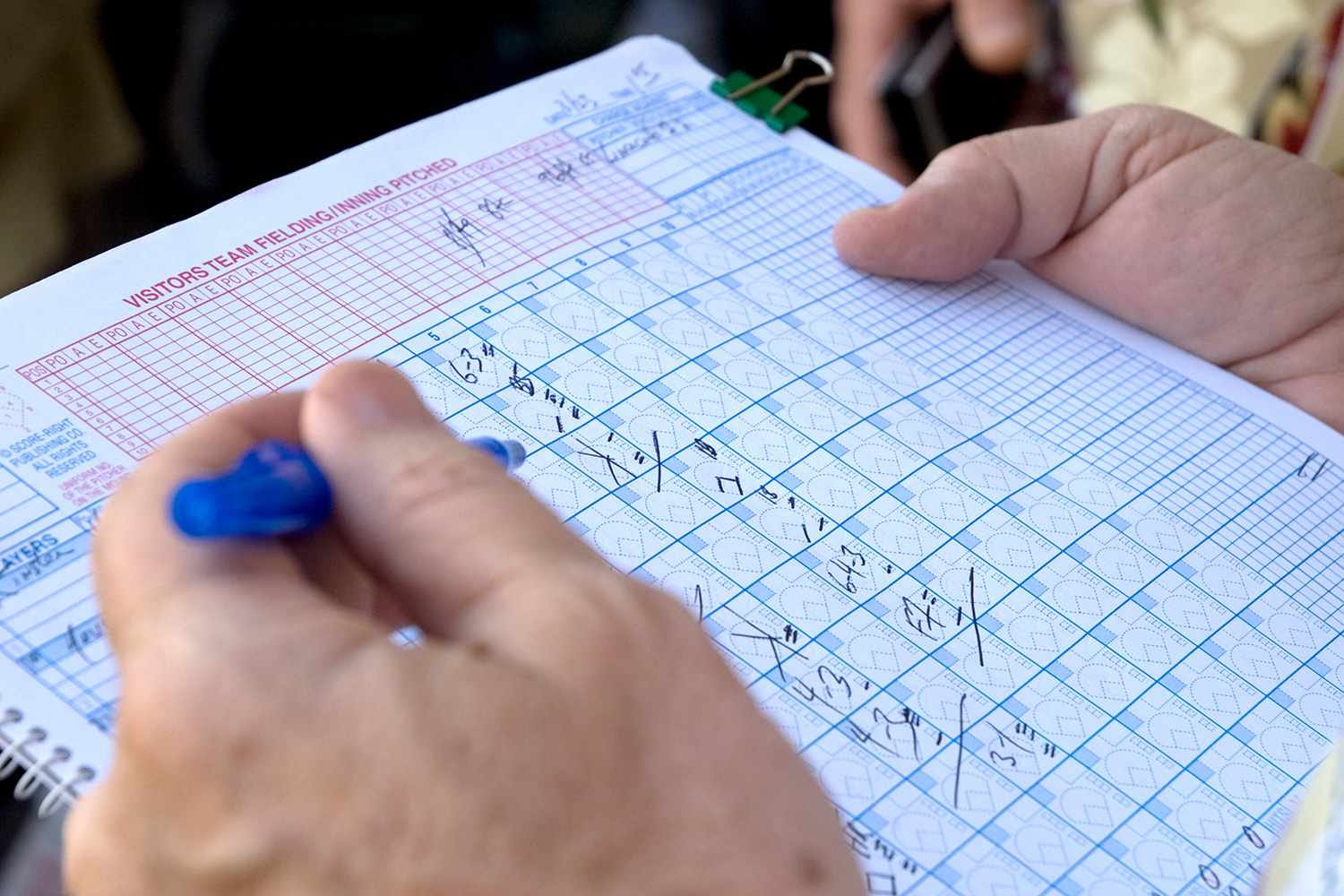
On a July night in 1990, I filled out the cleanest scorecard in my life.
It was at The Corner and Jack Morris—who was having a down year—was on the mound. The opponents were the Kansas City Royals.
In the top of the first inning, KC’s Kurt Stillwell grounded a one-out single into centerfield. Stillwell was promptly erased on a GB double play off the bat of the next hitter, George Brett.
That was it for Royals baserunners for the night.
After the Stillwell single, 25 hitters went to the plate and 25 were retired by Morris. But the drama of a potential no-hitter never existed, thanks to the first inning single.
That scorecard, at first blush, looked like a perfect game. It was without question the best game Morris ever pitched—including his 1984 no-hitter and his 10-inning gem in Game 7 of the 1991 World Series.
According to Baseball Reference, Morris threw 105 pitches at the Royals as I kept score that night, with 69 of them being strikes. Yet it was a mundane regular season game in July between two teams having bad years. And all it did was lower Jack’s season ERA to 5.04.
But still—it was the best game Morris ever pitched and I was there, scoring it. I still have the scorebook.
I’m sure as you’re reading this you’re thinking about your own baseball scoring style. Maybe you didn’t even really think that you have a style. But you do, no matter how clinical or creative.
Everyone does.
I wonder if baseball scorekeeping is still a thing among fans in attendance.
Does the younger generation keep score? Can they be bothered?
Speaking of legendary baseball announcers, the Yankees’ Phil Rizzuto introduced new lexicon into scorekeeping—all his own.
It was “WW.”
When asked what “WW” meant, Scooter said simply, “Wasn’t watching.”