
'Go Bird Go!'
Fifty years since Mark Fidrych made mincemeat of the mighty Yankees on national TV.

I’m at the age now (63 in August) where I now have crystal clear recall of events that are 50 years in the rearview mirror.
It wasn’t always that way.
Time was that a 50th anniversary of an event may as well have been like recalling (for me) something that happened in the days of black and white photos. Or newsreels.
Now? Fifty years is a drop in the bucket. May as well have happened last week.
Take Mark Fidrych’s coming out party on ABC Sports’ “Monday Night Baseball.”
We’re coming up on 50 years, you know (June 28).
But I won’t ask you to simply take my word for everything that I’m about to recall.
Let’s use some input from the horse’s mouth: The Bird himself.
The coming out party was, of course, the Yankees coming to town and Fidrych taking the mound in front of 47,855 (thank you Baseball Reference) fans at Tiger Stadium plus a TV audience in the tens of millions.
I have a feeling that the 47,855 figure has ballooned to more than 100K if you go by how many folks now claim to have been in the old ballpark that evening. That’s fine. I don’t blame them for such delusions of grandeur. For those of us watching on television, it did sort of feel like we were in attendance.
But back to Fidrych’s recall.
I had the great honor (and I mean that sincerely) of interviewing “Mahk” on the phone back in 2006 in my capacity as editor-in-chief for the defunct Motor City Sports Magazine. It was for one of those “Where Are They Now?” pieces and it marked 30 years of Fidrych’s magical 1976 season.
We ran the gamut in the 15+ minutes I had with him. Mark was kind enough to talk to me even though I caught him as he was out the door at his farm in Massachusetts.
So let’s revisit portions of that iconic night when those who knew little of Fidrych—believe it or not, those folks did exist on 6/28/76—were formally introduced to the boyish 21 year-old with the golden curls. But let’s do it through Mark’s eyes.
“I always got a ride to the ballpark for home games with (SS) Tommy Veryzer,” Fidrych explained as I was glued to my telephone.
“As we got closer to the stadium, Tommy looked at me and said, ‘This is the big time, kid. The Yankees. National television. Are you ready?’”
On that date, the Yankees, managed by old friend Billy Martin, were 43-24 and in first place in the AL East by 8 games. The Tigers were 32-35, 11 games behind in 4th place.
“I said, ‘Yeah I guess. I don’t know too much about their hitters.’”
This comment highlighted what so many found endearing about Mark Fidrych. These were the freaking NEW YORK YANKEES who were running roughshod over the league, and Fidrych not only said that he didn’t know too much about their hitters—he really didn’t!
This was way before advanced metrics and tablets in the dugouts and advanced scouting reports brought to you digitally. Back then, players (hitter and pitchers alike) kept “books” on opponents—and they were literal books. Not unlike a little black book that a Romeo might keep on all his Juliets.
Fidrych didn’t do that.
He relied on his coaches and what his teammates told him. This is a kid who didn’t know he had faced the great Hank Aaron (in 1976 a Brewer) until he was asked about the experience afterward, where the Bird struck Hank out.
"I did? Whoa! I struck out Hank Aaron! Here he is, I mean, a superstar, right? And here I am, a little guy, pitchin' to him."
No joke.
To The Bird, opposing hitters may as well have been interchangeable for all he knew about them. His philosophy was that if he kept the ball down and didn’t walk people, he’d be OK—no matter who was in the batter’s box. And in 1976, he pretty much was right about that.
But after he got to the ballpark and changed into his uniform, Fidrych told me that some butterflies did indeed kick in. But not because of the Yankees.
“I got some big crowds that year,” Mark said, as if this was news to me. “But that night it just seemed…bigger.”
Another endearing Fidrych thing: describing things with child-like simplicity. Mark threw phrases out there and we were left to decipher or fill in the blanks.
“So yeah I got a little nervous warming up,” he confessed.
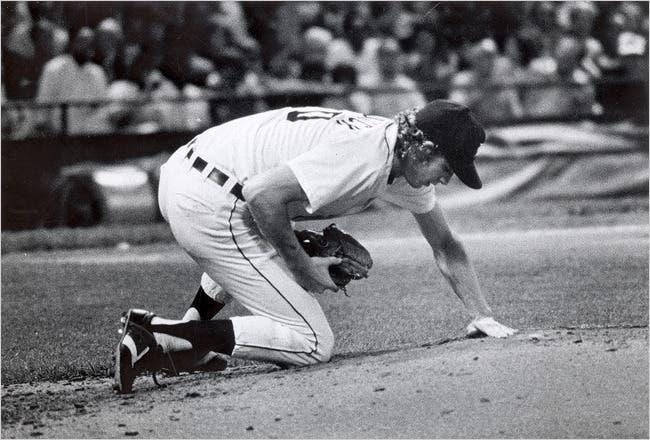
Fidrych mowed the vaunted Yankees down like he was a hot knife and they were butter. In the complete game win, he scattered seven hits, walked none and struck out just two as the ground ball was his best friend that night, as it was on many nights.
The only run Fidrych allowed was a solo HR by catcher Ellie Hendricks in the second inning.
The Tigers scored twice in the first inning off Yankees starter Kenny Holtzman (who then became a walking trivia question) and pecked away at the lefty for three more runs over the course of the game. Holtzman pitched all the way, as well.
And as usual for a Fidrych-thrown game, the Tigers dispatched their opponents with brevity: the game lasted 1 hour, 51 minutes. If Mike Hargrove was the Human Rain Delay, Mark Fidrych was the Human Pitch Clock. The Bird pitched as if he was double parked.
So ABC was able to air a full MLB game starting at 8:00 and not be late for their 10:00 programming.
In fact, the network had time to kill before 10, so not only was Fidrych interviewed on the field after the game (not a soul left the ballpark until after Fidrych came out for a curtain call), announcer Bob Uecker took to interviewing random fans he happened to grab nearby. Truth.
“It was crazy,” Fidrych told me over the phone. “It was so fun.”
But what I took from Mark’s recall was that he looked at that Yankees game as merely part and parcel of that entire ‘76 season, where we see it as a seminal moment in the creation of his legacy.
The “Fidrych Game” on ABC stands the test of time—and always will—because of the opponent, his dominance of said Bronx Bombers and that it served as the “official” unveiling of this lovable young man to the rest of the nation. It was like a motion picture that debuted in Detroit in May but didn’t open to the rest of the country until June 28. We got the sneak preview.
The performance also gave Fidrych an 8-1 record with a tiny ERA of 2.05.
The Yankees did try to mess with Fidrych’s rhythm—constantly stepping out of the batter’s box, stalling, etc. Graig Nettles took to visibly “talking” to his bat, mocking Fidrych’s habit of seemingly talking to the baseball (Mark was really talking to himself).
“If (Fidrych) can talk to the ball, then why can’t I talk to my bat?” Nettles explained later, tongue in cheek.
But it didn’t work.
As for the the game itself from a strictly baseball perspective, it meant nothing in the scheme of the standings or the pennant race. The Yankees finished 97-62, some 10.5 games ahead of second-place Baltimore. So complete was the Yankees’ division win that the league didn’t even bother to reschedule the 3 New York games that had been postponed earlier in the season.
The Tigers, meanwhile, were still a rebuilding group and finished 74-87 (5th place).
Mark and I also discussed his 1977 knee injury suffered in spring training while he was shagging flyballs (“I landed in the outfield funny and felt something slushy in my knee”).
“Rusty (teammate Staub) told me just before it happened, ‘Quit fooling around, Bird. You’re going to get hurt.’ And I did.”
We didn’t delve into anymore of that or the subsequent arm troubles because they had been written about ad nauseam.
Before he absolutely had to hang up the phone, Fidrych made sure to say one more thing.
“Tell everyone in Detroit that I love them.”
Done.